Logic puzzle guide
How to play and solve logic grid puzzles
The rules, a real puzzle from this page solved step by step on its grid, what changes between the levels, and which puzzle to print for whom.
How to play a logic puzzle
- Each person has exactly one thing from every column, and no two people share one.
- The clues are all true. Together they allow only one answer.
- Mark the grid: a check where two things go together, an X where they cannot.
- A check means X's for the rest of its row and column, inside that block.
- You are done when every block has one check in each row and column.
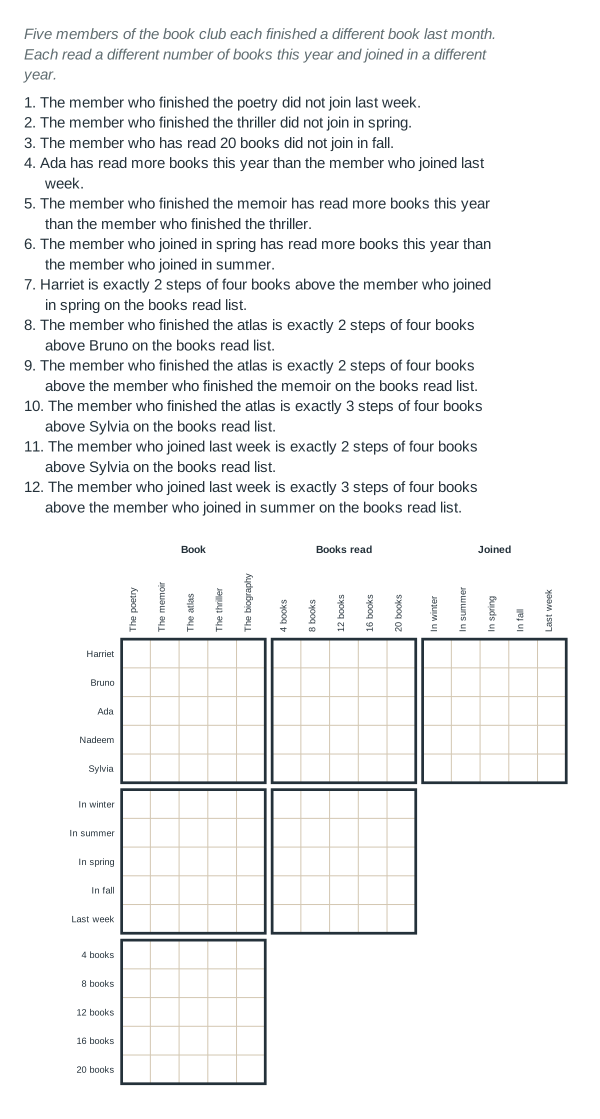
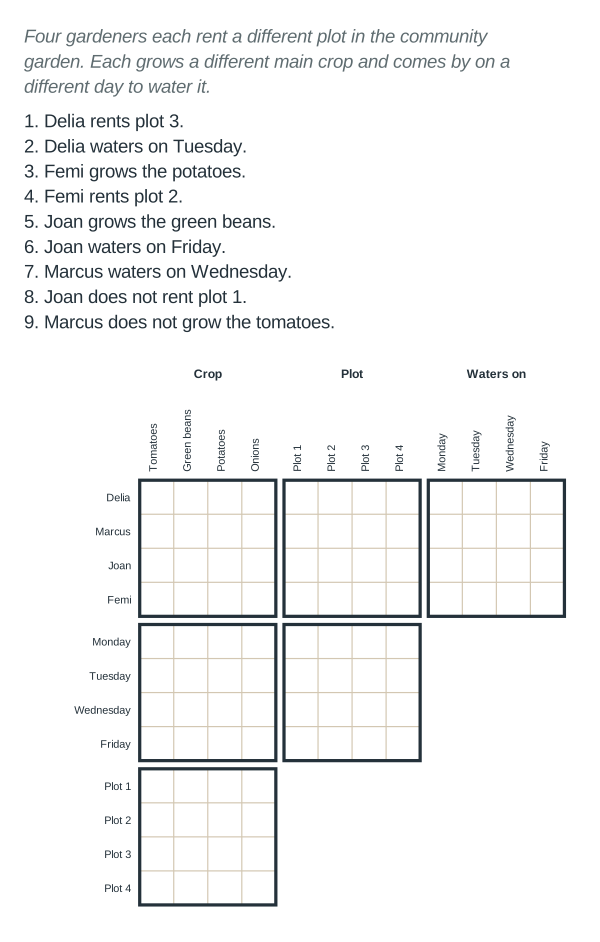
The grid is a staircase of blocks, one for every pair of columns, so that whatever you learn about two things has a square to go in. Here is an Easy puzzle from this page and its answer.
Four parents each brought something different to the school bake sale. Each sold theirs at a different price and set up at a different table.
- Ines charged $1.
- Wendy set up by the stage.
- Grace did not bring the brownies.
- Grace did not bring the cupcakes.
- Grace did not charge $2.
- Grace did not charge $3.
- Grace did not set up by the hall.
- Ines did not bring the cupcakes.
- Samir did not bring the brownies.
- Samir did not bring the cupcakes.
- Samir did not bring the lemon bars.
- Samir did not charge $3.
- Samir did not set up by the hall.
- Samir did not set up by the stairs.
The best-known puzzle of this kind, the Zebra Puzzle, appeared in Life International in 1962. It is often called Einstein's puzzle, but there is no evidence he wrote it.
How to solve a logic puzzle, step by step
Here is a Medium puzzle from this page, solved the way you would on paper. Every step was found by the same solver that checks each puzzle before it prints, so no mark is a guess. New marks are highlighted.
Four children each took part in a different event at field day. Each finished in a different place and is on a different team.
- Kit is on the Hawks.
- Osman is on the Ravens.
- Marta did not take part in the relay.
- The child in the relay finished second.
- The child in the relay is on the Falcons.
- The child in the sack race finished first.
- The child in the sack race is on the Ravens.
- The child who finished third is on the Owls.
- The child in the long jump did not finish fourth.
Step 1. Clues 1, 2 and 3 each name a person, so they go straight onto the grid. A check also means an X for the rest of its row and column: 2 checks and 11 X’s.
Step 2. Clues 4, 5, 7 and 8 link two things without naming anyone. Clue 4 says the child in the relay finished second, so anyone ruled out of one is ruled out of the other. That gives 2 checks and 17 X’s.
Step 3. Rows and columns with one square left: those squares are checks. Osman took part in the sack race. Idris took part in the relay. Idris is on the Falcons.
Step 4. Clues 4, 6 and 8 link two things without naming anyone. Clue 4 says the child in the relay finished second, so anyone ruled out of one is ruled out of the other. That gives 11 checks and 21 X’s.
Step 5. Rows and columns with one square left: those squares are checks. Marta took part in the long jump. Osman finished first. Marta finished third. Idris finished second.
That is the whole method: put the clues that name people on the grid, fill in rows and columns with one square left, and use the linking clues to carry each fact to its partner. When a clue links two things, read it both ways: whoever cannot have one cannot have the other.
When you are stuck
- Check the blocks between columns, not only the people's blocks. A linking clue usually goes there first.
- Copy every check across. In the puzzle above: The child in the relay finished second, and Idris took part in the relay, so Idris finished second.
- Reread the clues you have not used. Most only work once a few squares are filled.
- Count the X's in a row. Three X's in a row of four means the last square is a check.
Logic puzzle difficulty levels: what changes
Each level here is named for the step it forces, and a puzzle is only offered at a level once the solver has confirmed it cannot be finished without that step. Harder puzzles have fewer clues, not more: an Easy four-person puzzle averages 11.3 clues and an Expert one 7.1, because harder clues each say more and leave more for you to work out.
| Level | The step it forces | New kinds of clue | Clues, 4 people | Clues, 5 people | Words to read, 4 people |
|---|---|---|---|---|---|
| Easy | One square left in a row or column | Names a person and a thing; says someone did not | 11.3 | 17.7 | 94 |
| Medium | Carrying a fact through a third category | Links two things; says two things never go together | 9.8 | 12.7 | 108 |
| Hard | Arithmetic on the ordered column | Compares two places in the order; gives a gap in the order | 6.9 | 10.7 | 124 |
| Expert | Following a pairing until it breaks | None: the same kinds, fewer of them | 7.1 | 9.7 | 128 |
Averages over 12 four-person and 6 five-person puzzles at each level, made when this page is built. Every one needed its level's step and was confirmed by a separate search to have exactly one answer.
Read the levels as a ladder. Easy is reading clues onto the grid. Medium adds the step the grid exists for: carrying a fact through a third column. Hard adds a little arithmetic, such as "two places ahead", which rules out the ends of the line. Expert needs one more: pencil in a pairing, follow it, and if the grid breaks, the pairing was impossible.
Which logic puzzle to print
| Who it is for | Settings | Why |
|---|---|---|
| A first logic puzzle, ages 8 to 10 | Easy, 4 people, rules page on | Every clue names a person, so it goes straight onto the grid. About 94 words to read. |
| Ages 10 to 12 | Medium, 4 people | Linking clues teach the real skill, carrying a fact across the grid, on a grid that still fits on one page. |
| Middle school | Medium, 5 people, or Hard, 4 people | Five people means a longer clue list; Hard adds order clues with simple subtraction. |
| High school and adults | Hard or Expert, 5 people | Few clues, each doing a lot of work, and Expert needs a pairing tested to the end. |
| Seniors and large print | Easy or Medium, 4 people, large print | Bigger type and a bigger grid, and a story that finishes in one sitting. |
| A class set | Any level, 6 puzzles, answer keys on | A pack spreads across different stories, so neighbors are not working the same puzzle. |
- Answer keys come after the puzzles, as a table of who has what, which is quicker to mark than a filled grid.
- The rules page prints the method above on its own page, for a class or a first-time solver.
- Large print enlarges the clues and the grid together, so there is room to write in each square.
- New puzzles makes a new pack with the same settings, and each one is checked again before it prints.
Free to print, and what this page does not do
Every puzzle is made by this site's own generator in your browser and checked before it prints: every clue is true, the solver reaches the answer at the stated level, and a separate search confirms only one answer fits. More in how we make puzzle packs. The terms of use let teachers, clubs and families print and copy the puzzles and answer keys freely.
- There are 8 stories, the county fair pie contest, the community garden, the music lesson, field day, the school bake sale, the book club, the campsite and the pet show, so a regular solver will meet the same settings, though the clues and answers are always new.
- Puzzles have 4 or 5 people and three columns of things. Bigger magazine-style grids would not fit on one page with their clues.
- There are no picture puzzles for children who cannot read yet.