Killer Sudoku guide
How to play and solve Killer Sudoku
The rules fit in four lines. Solving starts with arithmetic you can do in your head, and below it is shown on a real puzzle from this page, one step at a time, with the reason for every digit.
How to play Killer Sudoku
- Fill every square with a digit from 1 to 9.
- Each row, each column and each 3×3 box uses every digit once, as in Sudoku.
- The dashed outlines are cages. The digits in a cage add up to the small total in its corner.
- A digit never repeats inside a cage, even when the cage bends around a corner.
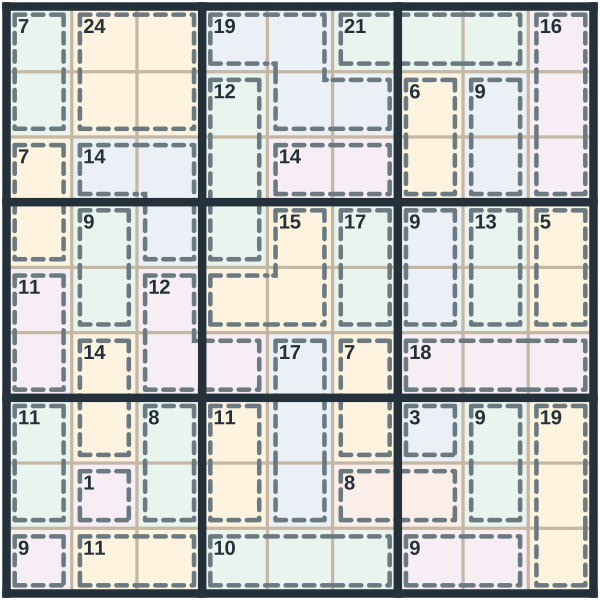
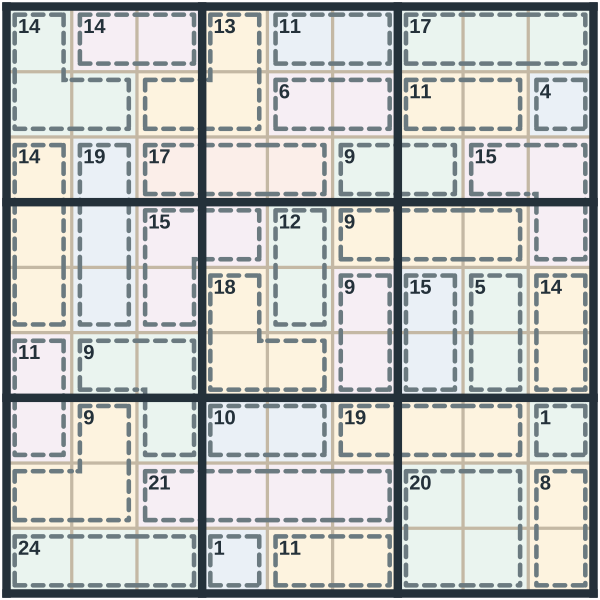
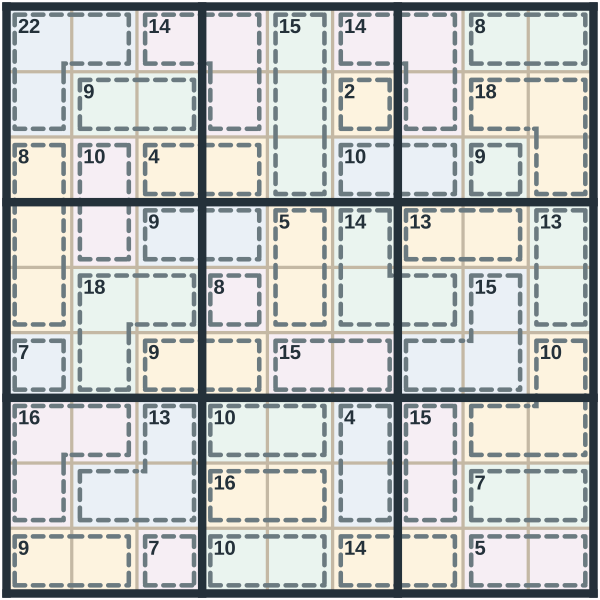
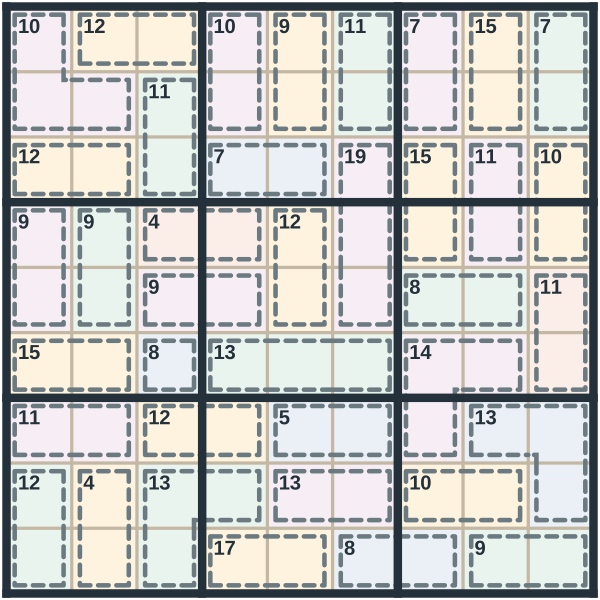
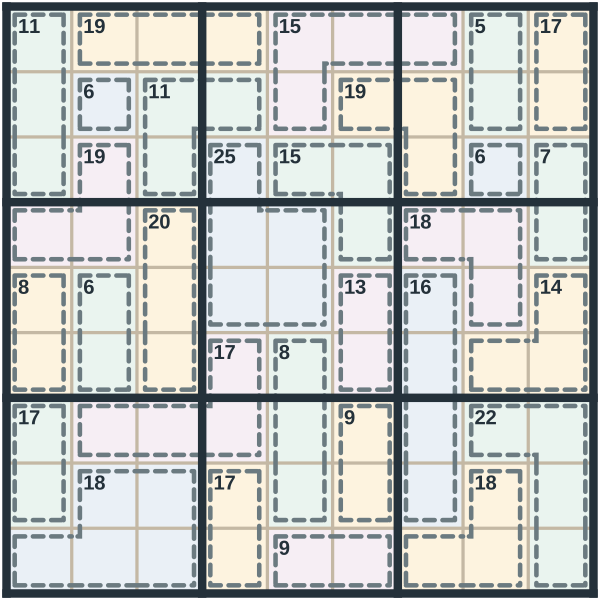
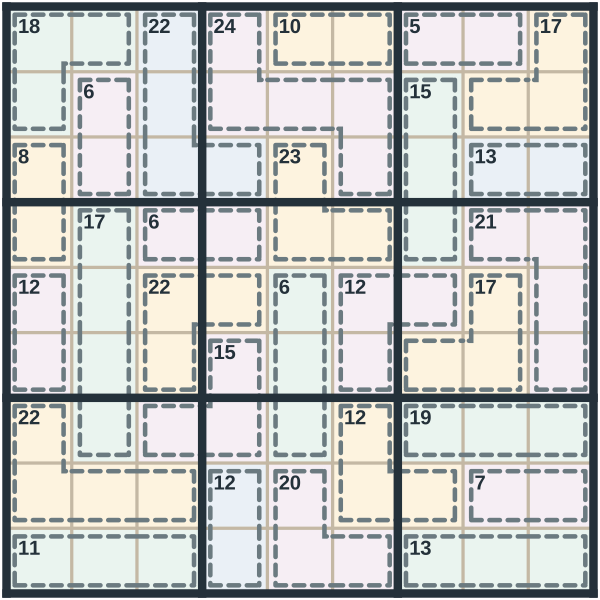
No digits are printed. The totals are the only clues, which is why Killer Sudoku is harder to start than Sudoku and why the first moves are arithmetic. Some sites call it Sum Sudoku or Sumdoku. It is a cousin of Kakuro, which uses the same kind of sums on a grid shaped like a crossword. Here is an Easy sheet from this page, and its answer.
How to solve a Killer Sudoku, step by step
This is an Easy sheet made by this page's generator, with 35 cages and no digits printed. It is solved below with five moves you can make on paper. Each step is computed from the puzzle, not written by hand, so the reasons are exactly what the grid allows. Highlighted squares are the ones a step fills, and a shaded row, column or box is the one it adds up.
Step 1. Three cages have a single square, so their totals are the digits: 4 at row 7, column 4; 3 at row 8, column 7; and 8 at row 2, column 8.
Step 2. The top-right box adds up to 45, and the cages that cover it total 50. The extra 5 is in the one square that sticks out of it, so row 3, column 6 is 50 − 45 = 5.
Step 3. The middle-right box adds up to 45. The cages lying wholly inside it total 43, so row 6, column 7 is 45 − 43 = 2.
Step 4. The 2-square cage totaling 10 already has 2, so its last square, row 6, column 6, is 10 − 2 = 8.
Step 5. The center box adds up to 45. The cages lying wholly inside it total 36, and 8 is already written in the rest of it, so row 6, column 4 is 45 − 36 − 8 = 1.
Step 6. The bottom-right box adds up to 45. The cages lying wholly inside it total 41, so row 9, column 7 is 45 − 41 = 4.
Step 7. The 2-square cage totaling 11 already has 4, so its last square, row 9, column 6, is 11 − 4 = 7.
Step 8. In column 3, the 7 can only go at row 4, column 3: every other empty square either already has a 7 in its row, column or box, or sits in a cage that cannot take a 7.
The rule of 45, both ways round
Every row, column and box holds 1 to 9, which add up to 45. Steps 2 and 3 use that in the two ways that matter:
- Cages lying inside (step 3). Add the cages that sit wholly inside the row, column or box. 45 minus that total is what its other squares hold.
- Cages covering it (step 2). Add every cage that touches the row, column or box, including the parts that stick out. That total minus 45 is what the sticking-out squares hold.
Across two rows the total is 90, and across three it is 135. That wider version is the innies and outies move Hard sheets need.
The other 71 steps use the same moves: last square in a cage (20), last square in a row, column or box (19), a digit with only one place left (28), a square with only one digit left (3) and the rule of 45 (1). Try them on the grid before you open the list.
Show steps 9 to 79
- The 2-square cage totaling 11 already has 7, so its last square, row 4, column 2, is 11 − 7 = 4.
- In column 3, the 4 can only go at row 8, column 3: every other empty square either already has a 4 in its row, column or box, or sits in a cage that cannot take a 4.
- The 2-square cage totaling 5 already has 4, so its last square, row 7, column 3, is 5 − 4 = 1.
- Row 3, column 7: its cage totaling 13 already has 5, so its other 3 squares must make 8, and that can only be 1 + 3 + 4. 3 and 4 are already in its row, column or box, so it is 1.
- Row 6, column 1: its cage of 2 squares must make 6, and that can only be 1 + 5 or 2 + 4. 1, 2 and 4 are already in its row, column or box, so it is 5.
- The 2-square cage totaling 6 already has 5, so its last square, row 5, column 1, is 6 − 5 = 1.
- In row 2, the 1 can only go at row 2, column 2: every other empty square either already has a 1 in its row, column or box, or sits in a cage that cannot take a 1.
- The 2-square cage totaling 8 already has 1, so its last square, row 3, column 2, is 8 − 1 = 7.
- In row 3, the 2 can only go at row 3, column 1: every other empty square sits in a cage that cannot take a 2.
- In row 4, the 1 can only go at row 4, column 8: every other empty square either already has a 1 in its row, column or box, or sits in a cage that cannot take a 1.
- The 2-square cage totaling 6 already has 1, so its last square, row 5, column 8, is 6 − 1 = 5.
- In the middle-left box, the 2 can only go at row 5, column 3: every other empty square either already has a 2 in its row, column or box, or sits in a cage that cannot take a 2.
- The 3-square cage totaling 9 already has 2 and 1, so its last square, row 6, column 3, is 9 − 3 = 6.
- In column 3, the 3 can only go at row 9, column 3: every other empty square sits in a cage that cannot take a 3.
- In column 2, the 3 can only go at row 1, column 2: every other empty square either already has a 3 in its row, column or box, or sits in a cage that cannot take a 3.
- The 2-square cage totaling 7 already has 3, so its last square, row 1, column 1, is 7 − 3 = 4.
- In column 1, the 3 can only go at row 4, column 1: every other empty square already has a 3 in its row, column or box.
- The 3-square cage totaling 11 already has 2 and 3, so its last square, row 2, column 1, is 11 − 5 = 6.
- In the middle-left box, the 8 can only go at row 5, column 2: every other empty square already has an 8 in its row, column or box.
- The middle-left box now has every digit except 9, so its last square, row 6, column 2, is 9.
- The 3-square cage totaling 22 already has 8 and 9, so its last square, row 7, column 2, is 22 − 17 = 5.
- Row 9, column 8: its cage of 2 squares must make 16, and that can only be 7 + 9. 7 is already in its row, column or box, so it is 9.
- The 2-square cage totaling 16 already has 9, so its last square, row 8, column 8, is 16 − 9 = 7.
- In row 7, the 7 can only go at row 7, column 1: every other empty square already has a 7 in its row, column or box.
- In column 1, the 9 can only go at row 8, column 1: every other empty square already has a 9 in its row, column or box.
- Column 1 now has every digit except 8, so its last square, row 9, column 1, is 8.
- The 4-square cage totaling 26 already has 7, 9 and 8, so its last square, row 8, column 2, is 26 − 24 = 2.
- Column 2 now has every digit except 6, so its last square, row 9, column 2, is 6.
- The 3-square cage totaling 11 already has 6 and 3, so its last square, row 9, column 4, is 11 − 9 = 2.
- The top-left box adds up to 45. The cages lying wholly inside it total 29, and 6 and 2 are already written in the rest of it, so row 3, column 3 is 45 − 29 − 8 = 8.
- In row 1, the 8 can only go at row 1, column 4: every other empty square either already has an 8 in its row, column or box, or sits in a cage that cannot take an 8.
- The 2-square cage totaling 11 already has 8, so its last square, row 2, column 4, is 11 − 8 = 3.
- In column 4, the 7 can only go at row 5, column 4: every other empty square already has a 7 in its row, column or box.
- The 2-square cage totaling 12 already has 7, so its last square, row 4, column 4, is 12 − 7 = 5.
- In row 6, the 7 can only go at row 6, column 9: every other empty square already has a 7 in its row, column or box.
- The 2-square cage totaling 10 already has 7, so its last square, row 6, column 8, is 10 − 7 = 3.
- Row 6 now has every digit except 4, so its last square, row 6, column 5, is 4.
- In row 1, the 7 can only go at row 1, column 7: every other empty square either already has a 7 in its row, column or box, or sits in a cage that cannot take a 7.
- In row 2, the 7 can only go at row 2, column 5: every other empty square already has a 7 in its row, column or box.
- The 2-square cage totaling 11 already has 7, so its last square, row 2, column 6, is 11 − 7 = 4.
- In row 2, the 2 can only go at row 2, column 9: every other empty square already has a 2 in its row, column or box.
- The 2-square cage totaling 11 already has 2, so its last square, row 1, column 9, is 11 − 2 = 9.
- In row 1, the 5 can only go at row 1, column 3: every other empty square already has a 5 in its row, column or box.
- Column 3 now has every digit except 9, so its last square, row 2, column 3, is 9.
- Row 2 now has every digit except 5, so its last square, row 2, column 7, is 5.
- The 3-square cage totaling 18 already has 7 and 5, so its last square, row 1, column 8, is 18 − 12 = 6.
- In row 3, the 3 can only go at row 3, column 9: every other empty square already has a 3 in its row, column or box.
- The top-right box now has every digit except 4, so its last square, row 3, column 8, is 4.
- Column 8 now has every digit except 2, so its last square, row 7, column 8, is 2.
- The 2-square cage totaling 10 already has 2, so its last square, row 7, column 7, is 10 − 2 = 8.
- In row 4, the 8 can only go at row 4, column 9: every other empty square already has an 8 in its row, column or box.
- The 2-square cage totaling 12 already has 8, so its last square, row 5, column 9, is 12 − 8 = 4.
- In row 5, the 9 can only go at row 5, column 7: every other empty square sits in a cage that cannot take a 9.
- Column 7 now has every digit except 6, so its last square, row 4, column 7, is 6.
- In row 7, the 6 can only go at row 7, column 9: every other empty square sits in a cage that cannot take a 6.
- In row 8, the 8 can only go at row 8, column 5: every other empty square already has an 8 in its row, column or box.
- In row 8, the 5 can only go at row 8, column 9: every other empty square already has a 5 in its row, column or box.
- Column 9 now has every digit except 1, so its last square, row 9, column 9, is 1.
- Row 9 now has every digit except 5, so its last square, row 9, column 5, is 5.
- In row 8, the 1 can only go at row 8, column 6: every other empty square already has a 1 in its row, column or box.
- Row 8 now has every digit except 6, so its last square, row 8, column 4, is 6.
- Column 4 now has every digit except 9, so its last square, row 3, column 4, is 9.
- Row 3 now has every digit except 6, so its last square, row 3, column 5, is 6.
- In row 1, the 1 can only go at row 1, column 5: every other empty square already has a 1 in its row, column or box.
- Row 1 now has every digit except 2, so its last square, row 1, column 6, is 2.
- In row 4, the 2 can only go at row 4, column 5: every other empty square already has a 2 in its row, column or box.
- Row 4 now has every digit except 9, so its last square, row 4, column 6, is 9.
- In row 5, the 6 can only go at row 5, column 6: every other empty square already has a 6 in its row, column or box.
- Row 5 now has every digit except 3, so its last square, row 5, column 5, is 3.
- Column 5 now has every digit except 9, so its last square, row 7, column 5, is 9.
- Row 7 now has every digit except 3, so its last square, row 7, column 6, is 3.
Those five moves finished this sheet, but not every sheet: of 12 other Easy sheets we tested, 1 fell to them alone. The rest also need pencil marks. Write the digits a cage allows small in each of its squares, cross them off as the rows and columns fill, and watch for a square left with one.
Three mistakes that cost the most time
- Counting only part of a cage. In the rule of 45, a cage that sticks out of the row counts in full. The overhang is the difference.
- Repeating a digit in a cage. A two-square cage totaling 10 can be 1 + 9, 2 + 8, 3 + 7 or 4 + 6, never 5 + 5.
- Reading a combination as an order. A two-square 3 is 1 and 2, but not which way round. Let the row or column decide.
Killer Sudoku cage combinations
The fastest start on any sheet is a cage whose total can only be made one way. These are all of them, for every cage size up to five squares. A two-square 3 must be 1 and 2; a two-square 10 could be four different pairs and tells you little on its own.
| Cage size | Totals with only one answer |
|---|---|
| 2 squares | 3 = 1 24 = 1 316 = 7 917 = 8 9 |
| 3 squares | 6 = 1 2 37 = 1 2 423 = 6 8 924 = 7 8 9 |
| 4 squares | 10 = 1 2 3 411 = 1 2 3 529 = 5 7 8 930 = 6 7 8 9 |
| 5 squares | 15 = 1 2 3 4 516 = 1 2 3 4 634 = 4 6 7 8 935 = 5 6 7 8 9 |
Worked out from every set of different digits when this page is built. Each cage size has exactly four such totals: the two smallest and the two largest it can make.
Show every combination for 2, 3 and 4 squares
| Total | Digits |
|---|---|
| 3 | 1 2 |
| 4 | 1 3 |
| 5 | 1 42 3 |
| 6 | 1 52 4 |
| 7 | 1 62 53 4 |
| 8 | 1 72 63 5 |
| 9 | 1 82 73 64 5 |
| 10 | 1 92 83 74 6 |
| 11 | 2 93 84 75 6 |
| 12 | 3 94 85 7 |
| 13 | 4 95 86 7 |
| 14 | 5 96 8 |
| 15 | 6 97 8 |
| 16 | 7 9 |
| 17 | 8 9 |
| Total | Digits |
|---|---|
| 6 | 1 2 3 |
| 7 | 1 2 4 |
| 8 | 1 2 51 3 4 |
| 9 | 1 2 61 3 52 3 4 |
| 10 | 1 2 71 3 61 4 52 3 5 |
| 11 | 1 2 81 3 71 4 62 3 62 4 5 |
| 12 | 1 2 91 3 81 4 71 5 62 3 72 4 63 4 5 |
| 13 | 1 3 91 4 81 5 72 3 82 4 72 5 63 4 6 |
| 14 | 1 4 91 5 81 6 72 3 92 4 82 5 73 4 73 5 6 |
| 15 | 1 5 91 6 82 4 92 5 82 6 73 4 83 5 74 5 6 |
| 16 | 1 6 91 7 82 5 92 6 83 4 93 5 83 6 74 5 7 |
| 17 | 1 7 92 6 92 7 83 5 93 6 84 5 84 6 7 |
| 18 | 1 8 92 7 93 6 93 7 84 5 94 6 85 6 7 |
| 19 | 2 8 93 7 94 6 94 7 85 6 8 |
| 20 | 3 8 94 7 95 6 95 7 8 |
| 21 | 4 8 95 7 96 7 8 |
| 22 | 5 8 96 7 9 |
| 23 | 6 8 9 |
| 24 | 7 8 9 |
| Total | Digits |
|---|---|
| 10 | 1 2 3 4 |
| 11 | 1 2 3 5 |
| 12 | 1 2 3 61 2 4 5 |
| 13 | 1 2 3 71 2 4 61 3 4 5 |
| 14 | 1 2 3 81 2 4 71 2 5 61 3 4 62 3 4 5 |
| 15 | 1 2 3 91 2 4 81 2 5 71 3 4 71 3 5 62 3 4 6 |
| 16 | 1 2 4 91 2 5 81 2 6 71 3 4 81 3 5 71 4 5 62 3 4 72 3 5 6 |
| 17 | 1 2 5 91 2 6 81 3 4 91 3 5 81 3 6 71 4 5 72 3 4 82 3 5 72 4 5 6 |
| 18 | 1 2 6 91 2 7 81 3 5 91 3 6 81 4 5 81 4 6 72 3 4 92 3 5 82 3 6 72 4 5 73 4 5 6 |
| 19 | 1 2 7 91 3 6 91 3 7 81 4 5 91 4 6 81 5 6 72 3 5 92 3 6 82 4 5 82 4 6 73 4 5 7 |
| 20 | 1 2 8 91 3 7 91 4 6 91 4 7 81 5 6 82 3 6 92 3 7 82 4 5 92 4 6 82 5 6 73 4 5 83 4 6 7 |
| 21 | 1 3 8 91 4 7 91 5 6 91 5 7 82 3 7 92 4 6 92 4 7 82 5 6 83 4 5 93 4 6 83 5 6 7 |
| 22 | 1 4 8 91 5 7 91 6 7 82 3 8 92 4 7 92 5 6 92 5 7 83 4 6 93 4 7 83 5 6 84 5 6 7 |
| 23 | 1 5 8 91 6 7 92 4 8 92 5 7 92 6 7 83 4 7 93 5 6 93 5 7 84 5 6 8 |
| 24 | 1 6 8 92 5 8 92 6 7 93 4 8 93 5 7 93 6 7 84 5 6 94 5 7 8 |
| 25 | 1 7 8 92 6 8 93 5 8 93 6 7 94 5 7 94 6 7 8 |
| 26 | 2 7 8 93 6 8 94 5 8 94 6 7 95 6 7 8 |
| 27 | 3 7 8 94 6 8 95 6 7 9 |
| 28 | 4 7 8 95 6 8 9 |
| 29 | 5 7 8 9 |
| 30 | 6 7 8 9 |
Cages of five squares or more
A cage of five squares uses five of the nine digits, so the four it leaves out add up to 45 minus its total. Look that up in the four-square chart, and the cage holds everything else. A five-square cage totaling 33 leaves out four digits making 12, which are 1 2 3 6 or 1 2 4 5. So the cage is 4 5 7 8 9 or 3 6 7 8 9. The same trick turns a six-square cage into a three-square one.
To print the chart with your puzzles, check Add the combinations chart in the builder. It goes in as one page after the puzzles.
Killer Sudoku strategies, from easiest to hardest
Every level uses cage combinations and the Sudoku basics. What separates them is the hardest move a sheet forces on top of those. Each puzzle here is graded by a solver that knows five moves, and the generator keeps going until that solver cannot finish the sheet without the level's own move. On the rare sheet where it stops short, the builder says so under the preview.
| Level | Hardest move it needs | What the move is | Cages | One-square cages | Largest cage |
|---|---|---|---|---|---|
| Easy | The rule of 45 on one row, column or box | Every row, column and box holds 1 to 9, so it totals 45. Add the cages inside one of them, and the difference is what the squares left over hold. | 34.0 | 3.0 | 4.0 squares |
| Medium | Pairs and triples | Two squares in a row, column or box that can only hold the same two digits take those digits away from every other square there. The same goes for three. | 36.3 | 2.0 | 3.3 squares |
| Hard | Innies and outies across two or three rows, columns or boxes | The same 45 arithmetic across two or three rows, columns or boxes at once, so a cage poking out of a band names a square several boxes away. | 28.7 | 1.0 | 4.7 squares |
| Expert | Testing a digit until it breaks a rule | Take a square down to two possible digits, pencil one in, and follow it until something breaks. If it breaks, the other digit was right. That is proof, not guessing. | 27.7 | 0.7 | 5.0 squares |
Averages from 3 generated sheets per level, measured when this page is built.
Harder sheets have fewer, larger cages: Easy averages 34 cages and Expert 27.7. A large cage says less, because its total can be made more ways, so the way in moves from a single cage to arithmetic across a whole row, column or box.
Which Killer Sudoku to print
Every sheet is a full 9×9, so the level is the choice that matters. These are the settings we would start from.
| Who it is for | Settings | Why |
|---|---|---|
| A first Killer Sudoku | Easy, color cages, rules page and combinations chart on | Easy sheets average 3 one-square cages, which are digits to start from, and the chart saves working out every total. |
| Children who already like Sudoku | Easy, color cages, name and date on | Cages of 4 squares at most, with totals up to 28: mental addition practice as well as logic. |
| Sudoku players trying Killer | Easy, then Medium | Medium is where pencil marks and pairs start to matter. |
| Older eyes | Easy or Medium, color cages, one per page | One per page, the default, prints the grid across most of the page, and the tints make each cage easy to follow. |
| Regular solvers | Hard | Fewer, larger cages, and the rule of 45 across two or three rows, columns or boxes at once. |
| Puzzle fans | Expert | At least one square where a digit has to be tested and followed until it breaks a rule. |
- Answer keys come with every PDF, two or four to a page, with no sign-up.
- Two per page makes the cage totals very small. One per page is easier to write in.
- Color cages make the outlines easy to follow but use a lot of ink across a class set. Black and white keeps the dashed outlines and photocopies cleanly.
- Ink saving thins the grid lines but keeps the cage outlines and totals at full strength.
- Every sheet is 9×9. Some sites print 6×6 Killer Sudoku for younger children; this page does not make those yet.
- Hard and Expert take a few seconds a puzzle to make, because each is checked to be solvable without guessing. If a sheet comes out easier than its level, the builder says so under the preview.
Free to print and copy
Every puzzle here is made by this site's own generator, in your browser, and checked before you see it: it has exactly one answer, and that answer can be reached without guessing. More on that in how we make puzzle packs. The terms of use let teachers, tutors, clubs and families print and copy the puzzles and the answer keys without asking.